Databricks upgrades ai_extract with Precision Mode
Databricks has introduced Precision Mode for its ai_extract API, a new feature designed to accurately pull structured data from highly complex, multi-page enterprise documents.
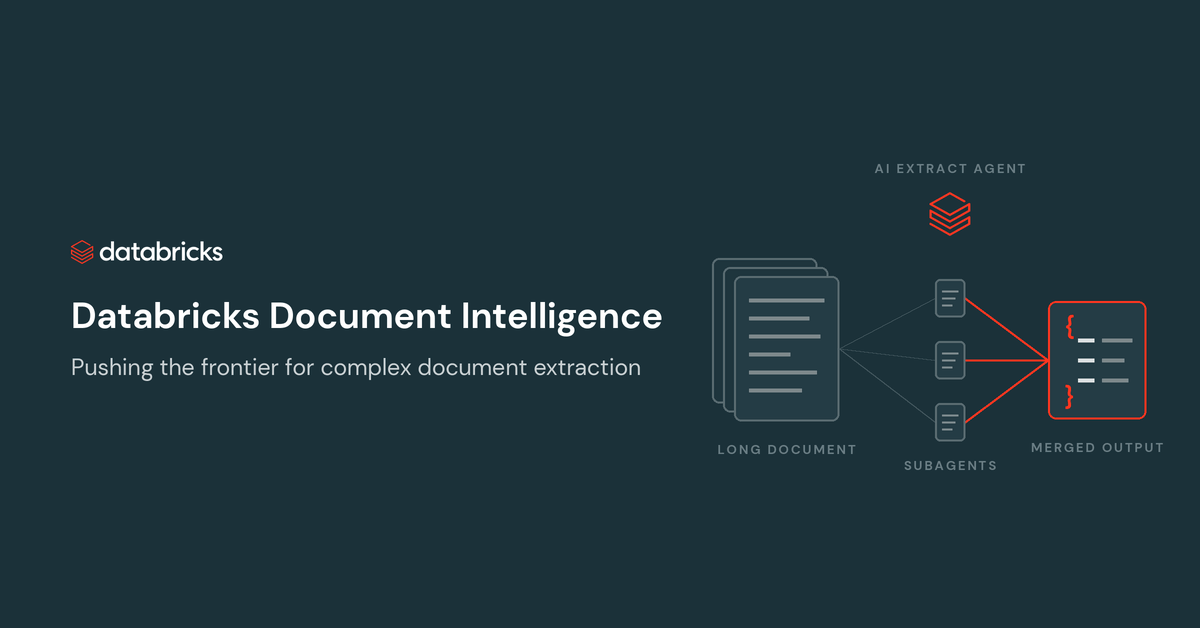
Databricks has launched Precision Mode within its document extraction API, ai_extract, to tackle the persistent challenges of processing highly complex enterprise files. Traditional large language models often struggle with long documents requiring cross-page reconciliation, massive nested outputs like thousands of invoice line items, and intricate schemas that demand multi-step reasoning. To resolve these issues, the new system pairs custom-tuned extraction models with an agentic harness that breaks down large jobs, processes them in parallel, and merges the results.
The architecture behind Precision Mode is inspired by Databricks MemEx. Instead of relying on a single massive general-purpose model, the system uses specialized models optimized specifically for structured extraction. Databricks evaluated the tool across roughly 9,000 documents from 10 internal datasets and five public benchmarks, including VAREX, RealDocBench, LongExtractBench, LEDGER, and the Caselaw Access Project. The test suite included documents up to 2,000 pages, schemas with over 300 nested fields, and dense financial tables.
In these evaluations, Precision Mode achieved 94.7% accuracy, outperforming the strongest frontier model baseline, GPT-5.6 Sol, by seven percentage points. While standard chunk-and-merge approaches using leading models from OpenAI, Anthropic, and Google frequently suffered from timeouts, truncated outputs, and schema mismatches, the Databricks system remained robust. Companies like Intercontinental Exchange are already using the technology to process millions of complex financial documents weekly.
For data engineers and developers, this release simplifies the pipeline for unstructured data. Instead of writing fragile, custom chunk-and-merge scripts or managing complex prompt engineering to prevent model timeouts, practitioners can now invoke a single API call. By setting the mode to precision within the ai_extract function or toggling it in the UI, teams can reliably convert messy PDFs, contracts, and financial statements into clean, structured tables ready for downstream analytics and agentic workflows.
This is our own summary of reporting by Databricks AI