Google Brings Gemma 4 12B to 16GB MacBook Airs
Google has released a local-ready version of its Gemma 4 12B model in the LiteRT-LM format, allowing developers to run multimodal AI offline on consumer laptops like a 16GB MacBook Air.
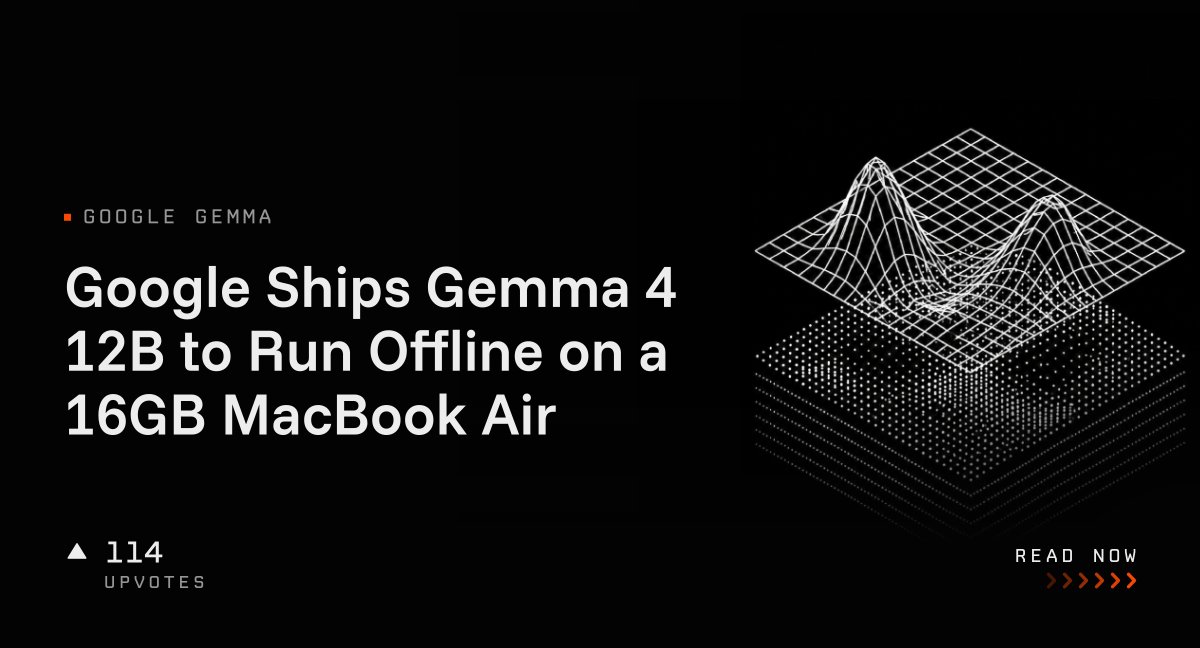
Google has launched a laptop-optimized build of its Gemma 4 12B instruction-tuned model, packaged in the new .litertlm format. The 6,883MB file enables offline, multimodal inference on standard consumer hardware, including a 16GB M4 MacBook Air. The model requires LiteRT-LM version 0.17 or later and consumes approximately 7.9 GB of GPU memory. Because Apple silicon uses unified memory, this footprint takes up roughly half of a 16GB MacBook Air's total memory before accounting for the operating system.
Performance benchmarks show that the 16GB MacBook Air can process a 1,024-token prompt at 114 tokens per second, yielding a 9.1-second time-to-first-token, and generate text at roughly 15 tokens per second. On a Linux system equipped with a discrete NVIDIA RTX 4090 GPU, performance jumps to between 50 and 69 generated tokens per second. The model supports a context window of up to 128k tokens on capable hardware, though Google's laptop benchmarks were run with a more constrained 4,096-token window. A separate web-only artifact, which is restricted to text inputs, was benchmarked in Chrome using a 1,280-token context.
The release leverages LiteRT-LM, an orchestration layer built on LiteRT (formerly TensorFlow Lite) that manages prompt formatting, key-value caches, and tool calls. It utilizes Multi-Token Prediction to generate several candidate future tokens in a single pass, reducing sequential decoding work and lowering latency. The package is distributed under an Apache-2.0 license, and developers can run it locally via the Google AI Edge Gallery app or by installing the library via pip and pointing the command-line interface at the litert-community/gemma-4-12B-it-litert-lm Hugging Face repository.
For developers, this release provides a Google-backed alternative to community tools like llama.cpp and MLX. By integrating model loading, cache management, and constrained tool calling under a single API layer, teams using Google's edge stack can easily build offline assistants and document tools. The runtime supports APIs for C++, Python, Kotlin, Swift, JavaScript, and Flutter, allowing developers to prototype on a command line and transition smoothly to production application code.
This is our own summary of reporting by AlphaSignal